November 1968: Richard Nixon elected president.
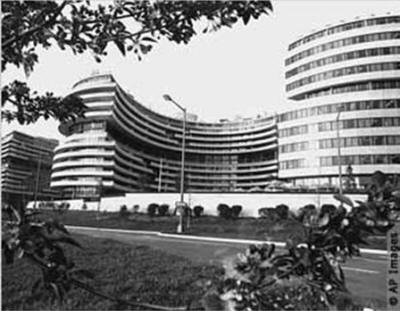
June 17, 1972: Five men arrested after breaking into the Democratic National Committee offices in the Watergate complex. One of the men says he used to work for the CIA.
August 1972: The Washington Post reports a $25,000 check apparently meant for the Nixon campaign ended up in the bank account of a Watergate burglar.
October 1972: The Post reports that the FBI believes the Watergate break-in was part of a political sabotage effort by the Nixon campaign.
November 1972: Nixon is reelected in a huge landslide.
January 1973: Two Nixon aides (G. Gordon Liddy, James McCord) are convicted in Watergate burglary.
April 1973: White House counsel John Dean is fired, the attorney general and two top White House staffers resign over the scandal.
July 1973: Former White House secretary tells Congress that Nixon taped all conversations in his office since 1971. Nixon reportedly orders tapes disconnected.
November 17, 1973: Nixon declares his innocence saying "I am not a crook."
December 1973: 18-1/2 minute gap found in one White House tape.
July 1974: Supreme Court orders White House to hand over 64 tapes of conversations. House passes first of three articles of impeachment.
August 8, 1974: Richard Nixon announces resignation.
May 31, 2005: Deep Throat is revealed as William Mark Felt
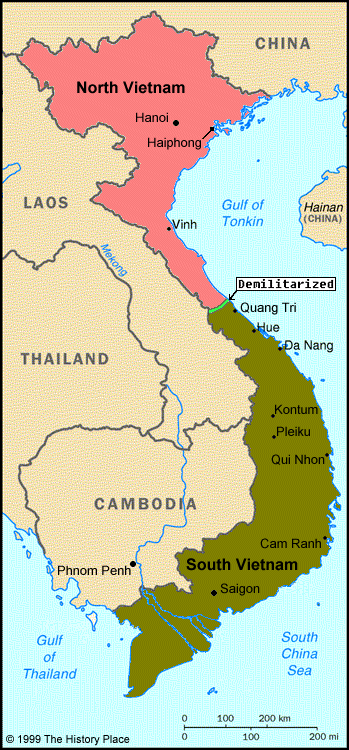 Aiming to achieve “peace with honor” in the Vietnam War, Nixon gradually reduced the number of U.S. personnel in Vietnam. Under his policy of “Vietnamization,” combat roles were transferred to South Vietnamese troops, who nevertheless remained heavily dependent on American supplies and air support. At the same time, however, Nixon resumed the bombing of North Vietnam (suspended by President Johnson in October 1968) and expanded the air and ground war to neighbouring Cambodia and Laos. In the spring of 1970, U.S. and South Vietnamese forces attacked North Vietnamese sanctuaries in Cambodia, which prompted widespread protests in the United States; one of these demonstrations—at Kent State University on May 4, 1970. After intensive negotiations between National Security Adviser Henry Kissinger and North Vietnamese Foreign Minister Le Duc Tho, the two sides reached an agreement in October 1972, and Kissinger announced, “Peace is at hand.” But the South Vietnamese raised objections, and the agreement quickly broke down. An intensive 11-day bombing campaign of Hanoi and other North Vietnamese cities in late December (the “Christmas bombings”) was followed by more negotiations, and a new agreement was finally reached in January 1973 and signed in Paris. It included an immediate cease-fire, the withdrawal of all American military personnel, the release of all prisoners of war, and an international force to keep the peace.
 Nixon's most significant achievement in foreign affairs may have been the establishment of direct relations with the People's Republic of China after a 21-year estrangement. The thaw in relations became apparent with the “ping-pong diplomacy” conducted by American and Chinese table-tennis teams in reciprocal visits in 1971–72. Nixon's visit to China in February–March 1972, the first by an American president while in office, concluded with the Shanghai Communiqué, in which the United States formally recognized the “one-China” principle—that there is only one China, and that Taiwan is a part of China.